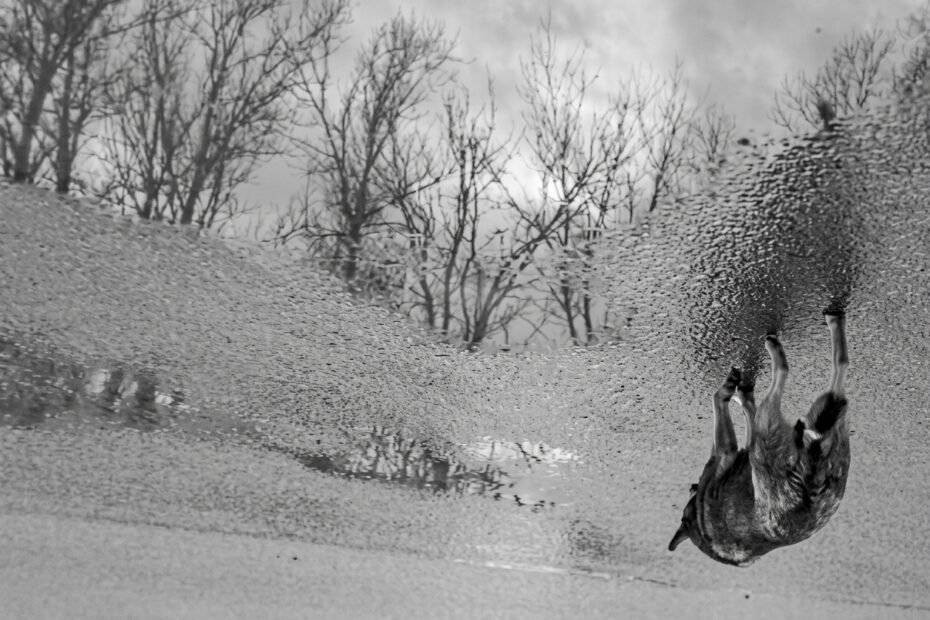
After centuries of legends, fear, warnings, and stories in which it almost always plays the role of the enemy, the wolf continues to walk among the trees, watching from a distance, in a territory we dare to enter only during daylight.
What lies behind our unease? A fury directed at our instincts, which, though domesticated, refuse to live by rules and distrust the little voice whispering that obedience is a virtue? We no longer fear the wolf in the same way; danger gives way to understanding. We have let go of the illusion that we can control what is wild. Now, it makes us smile whenever it refuses to meet our expectations.
Its solitary silhouette beneath an immense sky shows us the way inward, toward a place where the constant approval of others is no longer necessary. At the same time, the company of the pack does not require us to stop being ourselves.
In a society that often confuses success with competition and authority with imposition, the wolf can also symbolize collective intelligence. It protects its own without justifying every action in their name.
We all have a part of ourselves we prefer to keep hidden. I call it the shadow zone, where we throw our feelings and disguise them behind an acceptable reaction. We never grant our shadow zone the authority to rule us, yet it remains an unconscious force.
The wolf also represents the freedom to accept the consequences of our decisions, to relinquish the security of what is familiar, to tolerate being misunderstood by others, and to acknowledge that we cannot always hold on to the things we love.
The wolf cannot live outside the conditions of its nature. We, on the other hand, must learn to distinguish between the limitations that protect coexistence and those that seek to break our will. Is that not another form of captivity? Fleeing every bond for fear of dependence, destroying everything around us to prove that no one can control us, longing for security while dreaming of escape, or admiring strength only to distrust those who refuse to be subdued?
The wolf must be tired of representing our contradictions. Understanding it will not necessarily lead us to understand ourselves. From the wolf, we have learned to howl at the moon, but as long as we believe we must earn our place in the pack, we will never be free. In the end, we always see the wolf we want to see.
References
Contino, L. (2025). The Sepulcher of the Wolves.